College football history is filled with great teams that, for one reason or another, fell short of a national title. Today, if a team fails to win it all, it has nobody to blame but itself. But before the College Football Playoff, polls and politics could deny even a flawless team a shot at the crown.
The programs on this list rank among the greatest to ever take the field. Yet whether it was one bad night, one unlucky play, or simple circumstance, they never received the recognition they deserved. These are some of the best teams in college football history that never won a national championship.
1938 Duke Blue Devils and Tennessee Volunteers
The 1938 season produced two of the strongest teams never to be crowned champions, as Duke and Tennessee were both stuck behind a TCU squad led by Davey O’Brien, for whom the NCAA’s top quarterback award is now named. Duke’s defense nearly single-handedly won the national title for the Blue Devils, as they did not allow a single point to anyone during the regular season. The famed Iron Dukes did not have much offense, failing to reach double digits five times. But when you never give up a point, one touchdown is all you need.
Duke’s bid for a perfect season ended in the Rose Bowl, when USC backup quarterback Doyle Nave found Al Krueger for the first and only points the Blue Devils allowed all year. With Duke managing just a field goal, USC’s 7-3 win was enough to knock Duke from the ranks of the unbeaten.
Tennessee had no such issue, at least not in 1938. At that time, the SEC champion was not tied to the Sugar Bowl, so the Volunteers chose to test themselves against No. 4 Oklahoma in the Orange Bowl. Tennessee shut out the Sooners 17-0, marking their eighth shutout of the season for a defense that allowed just 16 total points all year. In a later era, Tennessee probably would have passed TCU, but the voters of 1938 and 1939 did not budge. Incredibly, the following year, Tennessee’s defense repeated Duke’s feat by giving up zero points for the entire regular season, only to see USC spoil another perfect year in the Rose Bowl.
1983 Nebraska Cornhuskers
If Nebraska had played consistent defense in 1983, the Huskers would not be on this list. Tom Osborne’s teams were usually defined by their famed Blackshirt defense, but not this one. The 1983 Huskers were known instead as the Scoring Explosion for the sheer number of points they piled up. Nebraska scored 654 points that season, averaging more than 50 per game. They dropped 84 on Minnesota, 72 on Iowa State, 69 on Colorado, and 67 on Kansas. By year’s end, Nebraska nearly made history as the first school to produce the top three picks in the NFL Draft, if not for the USFL. Wide receiver Irving Fryar and guard Dean Steinkuhler went first and second overall, while running back Mike Rozier was selected No. 1 in the USFL Draft.
The problem was that Nebraska’s defense feasted on the run-heavy attacks of the old Big Eight. The Huskers were vulnerable through the air, and Miami quarterback Bernie Kosar exploited that all night in the Orange Bowl. The hometown Hurricanes had nothing to lose. Ranked No. 5 entering the game, Miami watched as No. 2 Texas and No. 4 Illinois both lost, while No. 3 Auburn struggled to win its bowl against No. 8 Michigan. Still, even with Miami playing loose and confident, Nebraska rallied to make it 31-30 on a run by Jeff Smith, setting up a fateful decision for Osborne.
At that time, college football did not have overtime. In 1983, a tie at the end of regulation simply stood. Osborne could have kicked the extra point, taken the tie, and claimed his first national championship at 12-0-1. But that was not his way. He wanted to win it on the field. He went for two, hoping Turner Gill would find Irving Fryar for the game-winner.
Instead, Miami’s Ken Calhoun batted the ball away, sealing a 31-30 victory and the Hurricanes’ first national championship. The voters kept Auburn at No. 3 and elevated Miami to No. 1, ahead of Nebraska. That night marked the birth of the Hurricanes dynasty, as Jimmy Johnson would take over the next season and go 52-9 in five years. Osborne would have to wait 11 more years to finally win his first national title, against the same opponent in the same stadium.
1994 Penn State Nittany Lions
In just their second year in the Big Ten, Penn State may have fielded Joe Paterno’s best team. The Nittany Lions had Kerry Collins under center and Ki-Jana Carter running wild. They handled everything the Big Ten threw at them, including both past and present conference foes. With a non-conference slate that featured USC and Rutgers, the only opponent Penn State faced that isn’t currently in the Big Ten was Temple.
Unfortunately for the Nittany Lions, that schedule didn’t include Nebraska. The Huskers and Nittany Lions were universally viewed as the nation’s two best teams, but after Nebraska’s win over Colorado in late October, the Huskers took over the No. 1 spot and never gave it back. Two sluggish wins over Indiana and Illinois hurt Penn State in the eyes of poll voters, and to make matters worse, the bowl system at the time contractually locked the Big Ten champion into the Rose Bowl.
While Nebraska got to face No. 3 Miami in the Orange Bowl as part of the Bowl Coalition, Penn State was left to play Oregon, which finished 9-3 to win the Pac-10. The Nittany Lions dominated the Ducks, but it wasn’t enough. Nebraska’s comeback win over Miami secured Tom Osborne his long-awaited national title, leaving Penn State unbeaten, untied, and uncrowned.
1986 Miami Hurricanes
The end of the 1986 season brought a rare moment in college football. With both Miami and Penn State undefeated and clearly the two best teams in the country, the Fiesta Bowl seized the opportunity to stage the No. 1 vs. No. 2 showdown fans wanted.
Statistically, the game was a blowout. Penn State couldn’t handle Miami’s defense, managing only 162 yards of offense and one sustained scoring drive. But the Hurricanes kept sabotaging themselves with seven turnovers, including two critical mistakes in the fourth quarter. Penn State returned one interception to the Miami 5 to set up the go-ahead touchdown, and when the Hurricanes drove inside the Penn State 5 on their final possession, the Nittany Lions picked off Vinny Testaverde again to seal the national title.
It was Miami’s only loss in a two-year span. The Hurricanes dominated their way to a national title in 1987 and finished second to Notre Dame in 1988. But in 1986, they had their shot and literally threw it away. Multiple times.
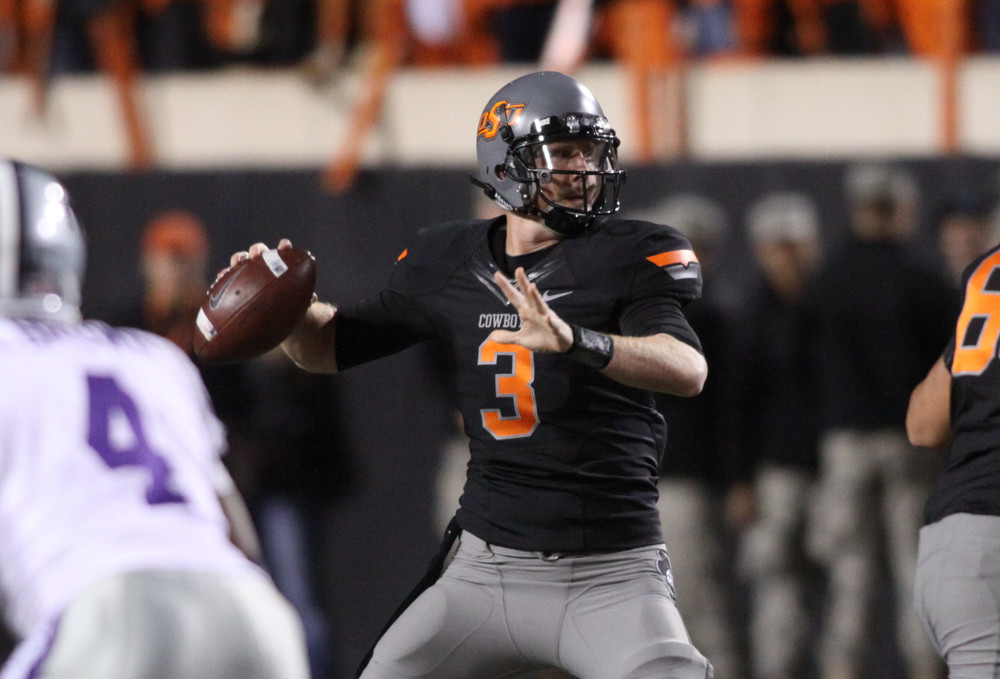
2011 Oklahoma State Cowboys
We’ll never know what might have happened if Oklahoma State hadn’t been rocked by tragedy the night before facing Iowa State. The Cowboys were ranked No. 2 behind LSU, and neither the Tigers nor the Tide looked impressive in their matchup that same week. Meanwhile, Oklahoma State was dismantling its opponents.
But on Friday night, Oklahoma State’s women’s basketball coach, Kurt Budke, was killed in a plane crash. Athletes form a tight-knit community, and many of the Cowboys’ football players and coaches knew Budke and his team personally. Head coach Mike Gundy and several players later admitted that no one really wanted to play the game, but the team was already in Ames and chose to go through with it.
Despite the tragedy, Oklahoma State nearly pulled off the win. But the Cowboys missed a field goal to end regulation, and Iowa State prevailed in double overtime. The loss dropped Oklahoma State behind Alabama, and with some help from manipulation in the coaches’ poll, the Cowboys never recovered. Several coaches ranked Oklahoma State fourth or lower, ensuring they couldn’t catch LSU for the title shot. Alabama got the rematch instead and dominated LSU, while Oklahoma State had to settle for beating Stanford in the Fiesta Bowl.
But at least the Cowboys can take solace in knowing they helped change the future landscape of college football. Outside the SEC footprint, nobody wanted this rematch. Most fans believed Alabama didn’t deserve another shot, which led to poor title game ratings, and many felt the result was unfair to Oklahoma State. The following year, the groundwork was laid for a four-team playoff, the model that eventually evolved into the system we have today.
Want more Sandman? Come connect with us here at sandmansports.com/onestopshop

Author