The lights dim in Pauley and you can almost hear the ghost of John Wooden pacing the hardwood. His pyramid not only whispers from the rafters but also hangs on the walls of fans and former players across the country. He is a legend who lives in the hearts and minds of everyone he coached and those of us who have admired his work ethic and soft touch from the distant sidelines.
The student section leans in and a blue and gold time machine slides onto the floor. One whistle and eras collide as the skyhook meets the touch pass, the fast break meets the backdoor cut, and grit meets grace. Welcome to a Westwood fever dream, the greatest five Bruins you could ever put on one floor.
Point Guard: Gail Goodrich (1962–65)
He was the original Bruin bucket getter in the Wooden era’s first act. Goodrich did not just run the show, he lit it up. He averaged 21.5 points per game for UCLA’s first title team in 1964, then dropped 42 points in the 1965 championship game against Michigan, a record at the time and still the stuff of Pauley legend (Sports-Reference box; NCAA recap). Quick off the bounce, ruthless from midrange, and fearless with pace, Goodrich gives this lineup a lead guard who can both organize the break and finish it.
Why him over Baron or Russ? Westbrook is a thunderclap and Baron is a highlight reel. But the Bruins’ dynasty turns on Goodrich’s balance. He scored like a two, thought like a one, and delivered banners when championships were still built, not branded.
Shooting Guard: Reggie Miller (1984–87)
You want gravity? Reggie is a law of physics. He is tied for third as UCLA’s No. 3 all-time scorer with 2,095 points. A cutter with a flamethrower and a late-game assassin before the three-point revolution became automatic, he was the prototype for players like Stephen Curry. Pairing Miller with Goodrich spaces the floor wall to wall as defenders chase him through a maze of Wilkes and Walton screens while Kareem posts life lessons on the block.
This team needs an off-ball mover who does not clog the paint. Reggie is the only Bruin on this list who never played for the legendary Wooden, yet his footwork, shot variety, clutch mindset, and follow-through were built for this movie.
Small Forward: Jamaal Wilkes (1971–74)
Silk. That is the scouting report. Two-time NCAA champion, two-time consensus All-American, and maybe the most playable wing in Bruins history. Wilkes defends up, rebounds down, runs like a deer, and turns broken plays into poetry. On this team he is the two-way connector: cuts, slips, swing, swing, bucket. If basketball is jazz, Wilkes is the clean horn line that keeps it all in rhythm.
Why not Marques Johnson? You could talk me into Marques on some nights, and he is first off the bench. But with two towers inside, Wilkes’ length, versatility, and calm efficiency fit best.
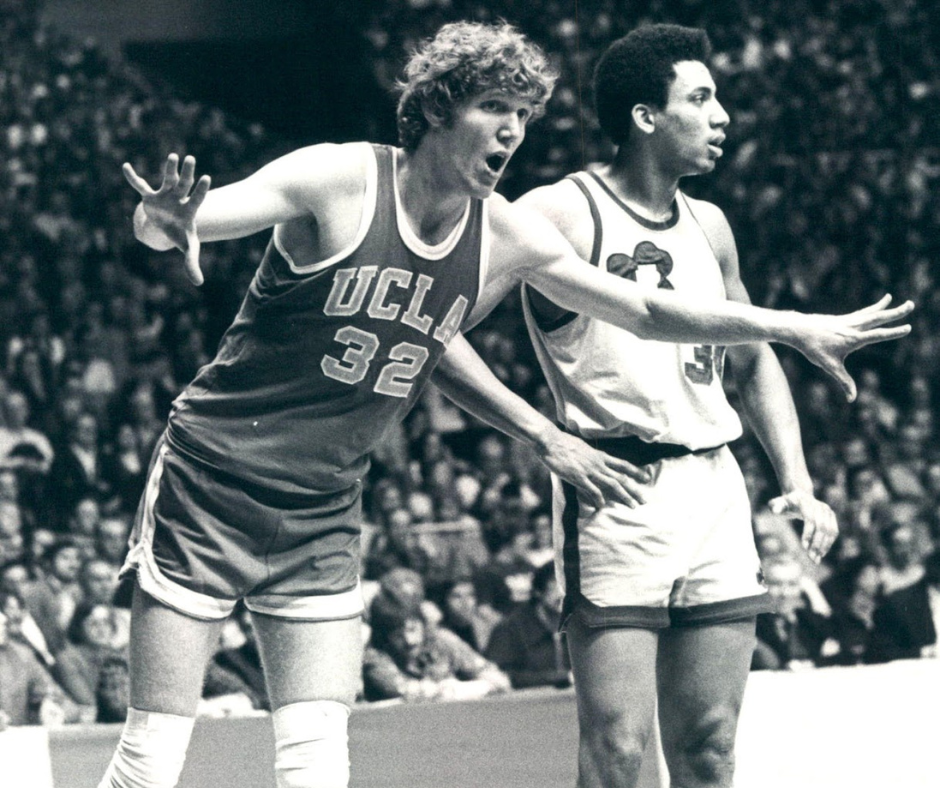
Power Forward: Bill Walton (1971–74)
If you only know TV Walton, meet College Walton. Thirty and zero. Thirty and zero again. Two titles. And the single greatest championship performance ever: 44 points on 21 of 22 shooting in their 1973 final vs. Memphis State. As a four next to Kareem, he becomes the world’s most devastating high-post quarterback, throwing blind bounce passes, running handoff screens, and hitting elbow jumpers that feel like layups. On defense, he erases mistakes and starts the break with outlet passes that hit Goodrich in stride.
Wooden preached fundamentals. In this lineup we are adding intimidation to go with them.
Center: Kareem Abdul-Jabbar (Lew Alcindor) (1966–69)
Three years. Three titles. Three Final Four MOPs, the only men’s player ever to do it (NCAA bio). A skyhook that still defies geometry. College Kareem is as close to inevitable as basketball gets. We put him on the block, tilt the floor, and dare you to send help, because when you do, a Walton pass becomes a Wilkes layup or a Reggie three.
Why Kareem over Walton at the five? Because when you can have both, you do not choose one. Kareem at center is non-negotiable. With Walton beside him, we are playing chess while everyone else is playing checkers.
Sixth Man and Rotation
Marques Johnson (1973–77) is our first sub, positionless before that word existed. The 1977 Wooden Award winner and national player of the year, he can guard four spots and score from anywhere. Walt Hazzard (1961–64), the 1964 Final Four MOP, changes tempo at guard. Sidney Wicks (1968–71) brings muscle if you need a bruising stretch. You could argue any of them into the five, and that is the beauty and the heartbreak of Westwood.
How They Win: Across Eras
Wooden’s principles cross decades: conditioning, spacing, work ethic, and unselfishness. We will run the classic high-post series through Walton, post Kareem into single coverage, and live in early offense. Defensively, we switch two through four with Wilkes as the glue, funnel drives toward two Hall of Fame shot blockers, and vacuum the glass. End games become a coach’s nightmare: double the post and die by kick-outs, or stay home and get skyhooked out of reach.
Betting Corner: Futures on the Current Bruins
The Bruins open the 2025–26 season ranked No. 12 in the AP poll. For those sneaking in a futures sprinkle, here is how the books line up as of October 18, 2025:
DraftKings: +3000 to +3500
FanDuel: Mid-longshot range
BetMGM: +3000 to +3500
If you believe in Cronin’s defense and roster continuity, you wait for a dip in December or January to buy a better number. If their offense outpaces expectations, the price will tighten fast.
The Wooden Thread
Ten titles in twelve seasons. Thirty-eight straight NCAA Tournament wins. An 88-game winning streak. The numbers feel fictional until you line up these names and realize that no program blends dominance and longevity like UCLA. This all-time roster is more than a fantasy lineup; it is a reminder that Wooden rewarded substance over flash. The roster reads like a syllabus in how basketball evolved, from post precision to high-post playmaking, wing efficiency, and guard pace layered together until opponents ran out of timeouts.
This piece lives in our Sandman Sports universe, where we believe sports are woven into our culture for the better in most cases. If you enjoy history told through highlight reels and heart, check out our Sports Culture and Fun series, including Baseball, Apple Pie, and Netflix: How Sports Influence Our Lives.
Want more Sandman? Come connect with us here at sandmansports.com/onestopshop

Author