Moneyball, Mojo, and the Cubs: The Big Business of Baseball and an Answer to 100 Years of Chicago Cub Fan Prayers
When Moneyball hit theaters in 2011, it did not just give us another underdog sports story, it pulled back the curtain on the cool, calculating, and oddly poetic world of baseball analytics. Brad Pitt as Billy Beane, the general manager of the Oakland A’s from 1998 to 2015, turned an old school (and I mean old school!) spreadsheet into a roadmap for success. Forget superstition, grit, or gut instinct. Beane built a competitive roster not on star power, but on stats like on-base percentage, walk rate, and overlooked efficiencies.
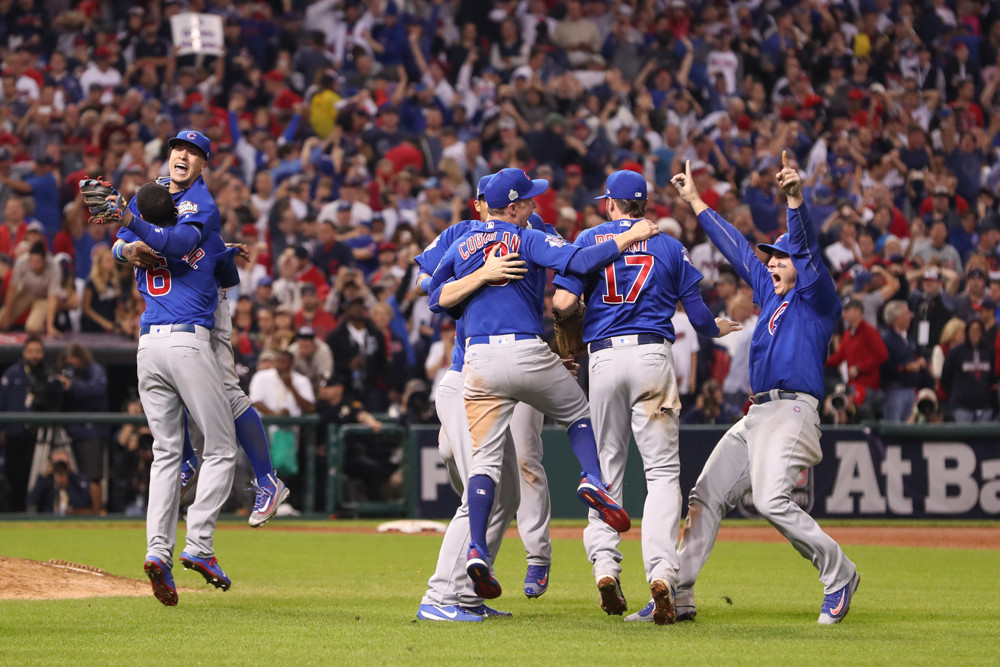
Fast forward to 2016, when my Cubs broke a 108-year curse and finally won the World Series! For my extended family this was a Christmas miracle in November, and if you were at Game 7 in Cleveland like we were, you know the Cubs and fans had a little help from the skies above. While the emotional headlines focused on curses, goats, and ghosts, underneath the surface was a calculating, Moneyball-informed machine, an organization led by Theo Epstein that had embraced data science, long-term strategy, and next-gen front office thinking that quietly built a farm system too good to worry about a curse carried by Boomers.
The Cubs of 2025 are a different breed altogether, built on Gen Z and Millennial talent and fans who grew up with a World Series title in their recent lifetime. “Wait until next year” takes on a whole new meaning because their current roster is a byproduct of these data-driven trades and a top-notch farm system of up-and-comers. Welcome to the new Chicago Cubs and baseball played by the numbers.
The Moneyball Philosophy: Undervalued Assets, Strategic Efficiency
The movie Moneyball was based on the prolific and always well researched work of author Michael Lewis. The storyline covers the financials of the Oakland A’s, who were broke by MLB standards. Beane and his assistant Peter Brand, a character inspired by real-life analyst Paul DePodesta and played by Jonah Hill in the movie, realized they could not afford to outbid the Yankees or Red Sox. So instead, they outthought them.
They identified undervalued players, often older, flawed, or just plain unfashionable, who still got on base. In doing so, they flipped the scouting world on its head. The scene in the movie where the old time scouts were picking players based on how attractive a player’s girlfriend was because that equaled confidence is hilarious and telling of old school ways that needed to evolve.
Beane’s key insight: the game is not just about runs, it is about run creation. That means finding players who maximize output relative to their cost. He was not only playing the odds, he was stacking them. As Pitt’s character says, “We are card captains. At the blackjack table. We’re going to turn the odds on the casino. ”
The A’s 2002 roster, built on statistical value instead of celebrity, went on to win 20 straight games, setting an American League record. That is the heart of the movie: challenging the Steinbrenner model of throwing more money at the roster, and finding hidden gems hiding in plain sight.
Enter Tom Ricketts and Theo Epstein: Building a Champion in Chicago
When the Ricketts family from Winnetka, IL bought the Cubs from the Chicago Tribune on October 27, 2009 for $845 million, a new Chicago baseball legacy began. Ricketts was not only a lifelong fan, likely as frustrated as the rest of us by watching our boys in blue fail to make October ball in what is clearly the best ballpark and place to watch a game in the world, but also a strategic business owner with the mindset to build a ballclub with a winning foundation.
In 2011, Ricketts hired Theo Epstein as President of Baseball Operations, who brought his Harvard-educated brain and likely a dog-eared copy of Lewis’ Moneyball with him. And he had something Billy Beane did not: Ricketts’ Ameritrade bankroll.
Epstein was a hot commodity and had already broken Boston’s 86-year World Series drought with a 2004 championship. In Chicago, he applied similar principles but with a broader lens. His team fused advanced analytics with traditional scouting. They invested in and built a farm system like the Cubs had never seen. They prioritized character, clubhouse chemistry, and high on-base percentage. And they hired Joe Maddon, whose leadership, good humor, and “try not to suck” player-focused coaching built a winning and positive culture the Cubs had not seen in my lifetime.
Like Beane, Epstein believed in undervalued assets, but he had the budget to buy a few premium players when needed. The Cubs were Moneyball 2.0.
The 2016 Cubs: Analytics, Heart, and Just Enough Magic
By 2016, the Cubs were a case study in how modern baseball organizations build dynasties from the ground up.
- On-base and walk rate were key metrics used in assembling the batting lineup. Players like Anthony Rizzo and Kris Bryant were more than power hitters, they got on base consistently.
- Pitch framing and defensive metrics guided decisions behind the plate, including the value of catcher Miguel Montero.
- Player development was prioritized over splashy free agency. Most of the roster came from a rebuilt farm system.
- Game strategy was influenced by data, but never ruled by it. Manager Joe Maddon brought unorthodox style, an iPad, and a willingness to switch up the lineup daily, all backed by a front office steeped in analytics.
Their World Series win was not luck, it was long-term planning, deep analytics, and emotional intelligence rolled into one.
Why Moneyball Still Matters
Even in an era where AI and machine learning are infiltrating every industry, Moneyball and especially the Cubs 2016 team are a present day blueprint for understanding modern sports culture. Besides the highlight clips and box office sales, the foundational facts taught us that:
- Data can reveal what tradition overlooks.
- Value is not always visible to the average fan.
- Strategy beats instinct in the long run, but chemistry still matters.
In the Cubs’ story, we see what happens when Moneyball is given room to breathe, evolve, and scale. It is no longer about doing more with less, it is about doing smart with more.
From the Front Office to the Betting Apps
The legacy of Moneyball reaches beyond baseball insiders. Today’s fans track advanced stats like WAR (Wins Above Replacement), a formula that measures a player’s unique contribution to wins against a replacement player. They track launch angle and exit velocity to predict hits and home runs. Fantasy leagues and sports betting rely heavily on predictive modeling, which will only gain accuracy the faster AI models learn.
Even other sports, basketball, soccer, and football, have adopted Moneyball’s premise. The NFL now employs entire departments focused on next-gen stats. Premier League teams hire data scientists. What started as a baseball experiment is now a sports culture revolution and overdue evolution.
Cubs 2016: The Intangibles Still Matter
Yes, the 2016 Cubs had metrics. But they also had mojo.
They had stories that supercharged their mojo and a little skill-fueled luck like: David Ross hitting a home run in his final game, the crowd at Wrigley Field after winning the NLCS deciding Game 6 hitting noise levels louder than anything I have ever heard at Wrigley when the Cubs beat the Dodgers 5-0 to advance to their first World Series since 1945, and who can forget Dexter Fowler leading off World Series Game 7 with a first-ever leadoff homer that came right at me as I used my standing room only ticket to wander the stadium that first inning in Cleveland, finally landing in the same section as my family after the rain delay speeches that became legend.
They had ghosts, curses, Steve Bartman (who the Ricketts front office even tried to bring back and make amends), Billy goats, and generational heartbreak for the lovable losers no more.
But underneath it all, they had a plan, a long, strategic, analytics-infused roadmap that turned a lovable losing franchise hosted at the world’s best outdoor beer garden into a world champion.
Final Inning: Moneyball’s Message for Today
In the age of AI, NIL deals, and algorithmic everything, Moneyball reminds us that success is not about flash, it is about insight, depth, and showing up. Hard work still pays off. And the Cubs’ 2016 run reminds us that while numbers guide the journey, it does not happen overnight. Ultimately, it is still the human moments that make the game worth playing and watching.
So the next time someone tells you baseball is just a game, remind them: it is also a business, a blueprint, and, when done right, a story that changes everything.
If you enjoyed this article, you may want to check out these too:
Netflix & How Sports Influence Our Lives
Want more Sandman? Come connect with us here at sandmansports.com/onestopshop

Author