Latest
Ranking the Big Ten’s Top Coaches in 2025
Power rankings usually shine the light on the players, but here the spotlight shifts to the men calling the shots on the sidelines. Ranking coaches is always subjective, a blend of career résumé and current results, but there is no denying their influence. A head coach shapes how a program competes in the present, how it is built for the future, and even how bettors look at close games and live markets.
From proven leaders to fresh faces, the Big Ten sideline is stacked with coaching power. Some bring championship résumés, others bring new energy and momentum, but all are shaping the league’s most important storylines. In a conference this deep, the coaches are every bit as competitive and unpredictable as the games themselves.
Here’s how the Big Ten coaches stack up, through a Sandman Sports lens:
1) Ryan Day – Ohio State (3-0, 0-0)
New Hampshire‑bred QB under Chip Kelly, sharpened by NFL QB rooms (49ers, Eagles), Day took the Ohio State helm in 2019 after a three‑game interim turn in 2018 and delivered the 2024 national title. Of course he sits atop the Big Ten Coach Power Rankings: he builds quarterback‑friendly plans and has developed a consistent defense with little variance. Three weeks into 2025 and that profile looks familiar with a 14–7 win over then No. 1 Texas and two “take care of business” victories against overmatched opponents. Books shade the Buckeyes on the road because Day’s teams rarely beat themselves late.
2) Dan Lanning – Oregon (4-0, 1-0)
Forged as Georgia’s defensive coordinator during the 2021 national championship run, Lanning brought that ruthlessness to Eugene in 2022. He powered Oregon to last season’s Big Ten title with a 45–37 win over Penn State. His Ducks are off to another hot start with a 69–3 rout of Oklahoma State and a 41–7 win over rival Oregon State. Lanning’s defenses create field position and points, and his Ducks now face Penn State in a White Out that could define the season.
3) James Franklin – Penn State (3-0, 0-0)
The White Out is Franklin’s stage, and the arc that put him here started with Vanderbilt’s renaissance (2011–13) before he took over at Penn State in 2014 and won the 2016 Big Ten title with a stack of New Year’s Six trips since. That portfolio shows up in late‑game management and situational football. Hosting No. 6 Oregon and ESPN’s College GameDay, Franklin’s history of organized chaos at home nudges the live line toward PSU. I’m betting on Franklin’s calculated use of time coupled with Drew Allar’s efficient composure, and amped up fans still smarting from last season’s title snatching to put Penn State ahead when the buzzer sounds.
4) Lincoln Riley – USC (4-0, 2-0)
From four straight Big 12 titles at Oklahoma to producing Heisman winners in Baker Mayfield, Kyler Murray, and Caleb Williams, Riley’s identity is efficiency and explosiveness. Despite some recent season disappointments at USC, Riley is still an elite coach and is starting to find his footing in the Big 10. His scripted openers and quarterback development win early momentum and stretch margins. USC is favored this weekend at Illinois, and if the Trojans jump ahead early, Riley’s tempo could overwhelm the Illini.
5) Curt Cignetti – Indiana (4-0, 1-0)
Cignetti built winners at James Madison, Elon, and IUP before arriving at Indiana, and he has quickly instilled the same structure and efficiency in Bloomington. A dominant win over ranked Illinois showed that this team is for real in 2025. Quarterback Fernando Mendoza, now a legitimate Heisman front runner, has been a huge part of the turnaround, but Cignetti deserves equal credit for transforming a program once seen as a Big Ten punchline. How far the Hoosiers can climb this season and whether they can sustain it beyond has become one of the most captivating storylines in the conference.
6) Sherrone Moore – Michigan (3-1, 1-0)
Moore’s credentials are clear. As Michigan’s offensive line coach and play-caller he guided the Wolverines to back-to-back Joe Moore Awards in 2021 and 2022. As acting head coach in 2023, he kept the eventual national champions on track. As full-time head coach in 2024, he beat Ohio State and Alabama. Despite serving suspensions, Moore’s identity is intact: a physical run game, strong protection rules, and steady development of freshman quarterback Bryce Underwood. Books treat Michigan the same as always: grinding games down in the fourth quarter.
7) Jedd Fisch – Washington (3-0, 0-0)
Fisch’s career spans both the NFL and NCAA, with stints under Bill Belichick and Steve Spurrier. He turned Arizona into a winner before landing at Washington in 2024. His sequencing (tempo, formations, and quarterback movement) lets underdogs punch above their weight. Preparing for Ohio State, Fisch has built a balanced plan with quarterback Demond Williams Jr., downhill runs, and red-zone efficiency. His game plans generate explosives without losing control, which is why Washington gets market respect even against No. 1 Ohio State.
8) Matt Rhule – Nebraska (3-1, 0-1)
Rhule rebuilt Temple, then Baylor, and now Nebraska. His formula is discipline and physicality. The Cornhuskers are back to bowl viability, and oddsmakers note that his teams typically cut down mistakes as the season progresses. That profile makes Nebraska a sneaky play when betting tight totals.
9) Luke Fickell – Wisconsin (2-2, 0-1)
Fickell led Cincinnati to the 2021 College Football Playoff, the first Group of Five team to reach the semifinals. At Wisconsin in 2025, his team has stumbled to 2–2 after a 27-10 home loss to Maryland. Special-teams miscues, turnovers, and quarterback injuries told the story of that game. For Fickell’s sake, we will give him the benefit of doubt and assume those are fixable problems. But his seat is getting hotter in Madison, and this may be a generous ranking when we look back at the end of the season.
10) Kirk Ferentz – Iowa (3-1, 1-0)
Ferentz became the Big Ten’s all-time wins leader earlier this season, passing Woody Hayes with a victory over Massachusetts. His method is unchanged: complementary offense, field position, and suffocating defense. The Hawkeyes are always tough and well prepared, and their offense is a far cry from what it was two years ago. Why No. 10 then? This is a coach ranking that weighs current‑season trajectory alongside career stature. Iowa is rock-solid week to week but the passing game fails to create quick scores. Against top opponents, that limits how much Iowa can pull ahead. Even on a bad day, Ferentz’s Hawkeyes rarely fold under pressure so he belongs in the top 10, but the ceiling of this year’s team feels lower than the programs above them.
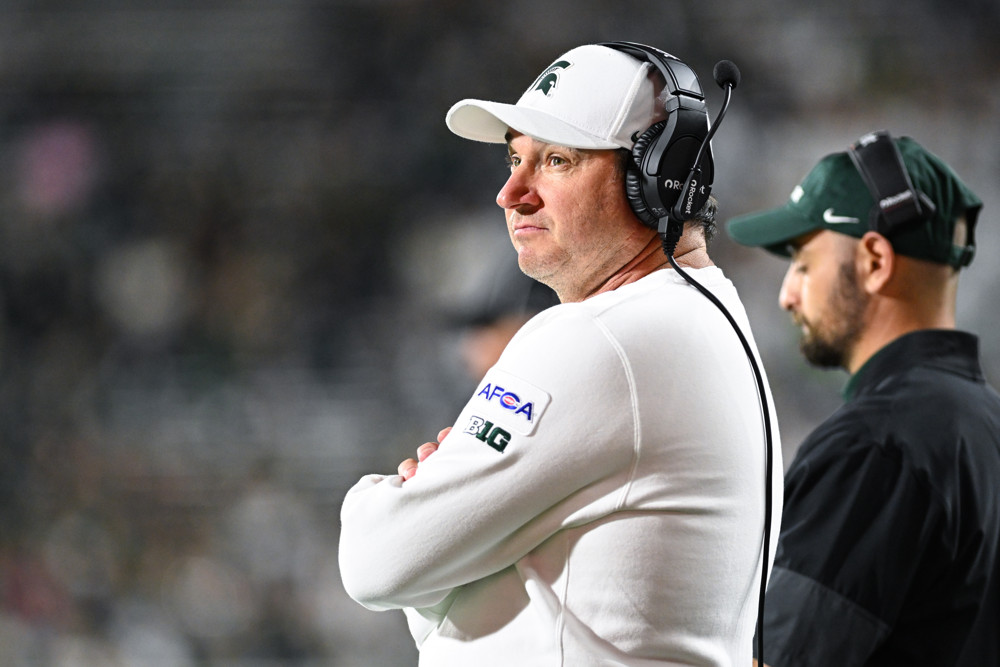
11) Jonathan Smith – Michigan State (3-1, 0-1)
Smith, once a walk-on quarterback at Oregon State, rebuilt his alma mater before making the move to East Lansing. His coaching identity centers on balance, creative play-action, and explosive design. Michigan State dropped a competitive matchup with USC, but Smith has already instilled a more physical running game, a tougher mindset, and a disciplined approach that is clearly moving the program forward.

12) Bret Bielema – Illinois (3-1, 0-1)
Bielema’s coaching identity has always been built on trench dominance, patience, and physical play. At Wisconsin, that approach delivered three straight Big Ten titles, and he has brought the same formula to Illinois. The lopsided loss at Indiana last week was an outlier, and I expect the Illini to be ready to battle in a close one versus USC. Winning consistently in Champaign has never been easy, but Bielema is proving that it can be done.
13) Greg Schiano – Rutgers (3-1, 0-1)
Twice the builder in Piscataway (2001–11, 2020–present), Schiano’s program has a hard ceiling but a rapidly rising floor. His NFL and college stops solidified a defense‑first mindset that shows up against the spread. With three non‑league wins before a setback to Iowa, Schiano’s building again. That trajectory (rising floor, still‑developing ceiling) fits him at No. 13. If you’re considering the over/under take into account that Rutgers forces long fields and ugly possessions, which makes covering double digits against the Knights an uphill climb.
14) Mike Locksley – Maryland (4-0, 1-0)
Locksley’s recruiting and quarterback development are paying off. Maryland is undefeated after a statement win at Wisconsin with freshman quarterback Malik Washington shining. This year’s squad looks fresh and competitive, and this ranking may already be underselling him. His recent game‑control profile is why totals and team‑overs are rising into October and this team could continue to surprise and rise. Still, I need to see Maryland sustain this level through the heart of Big Ten play before pushing Locksley into the top ten.
15) P.J. Fleck – Minnesota (2-1, 0-0)
Fleck made his name at Western Michigan and has carried that culture-driven, ball-control identity to Minnesota. But now in his ninth season with the Gophers, the results have been uneven. Outside of his spectacular 11–2 run in 2019, the program has hovered in mediocrity. A 58–39 overall record is far from inspiring in the Big Ten and keeps him planted near the bottom of these rankings.
16) David Braun – Northwestern (1-2, 0-1)
Promoted to head coach in 2023 after the Pat Fitzgerald fallout, Braun delivered a bowl win and Coach of the Year honors. Northwestern is limited, and it plays tough as an underdog, so maybe this is unfair to Braun. But results matter in these rankings and his overall record in Evanston is 13-15.
17) Ryan Walters – Purdue (2-2, 0-1)
Walters established himself by building top-20 defenses as a coordinator before taking over Purdue in 2022. His identity is rooted in defense and a relentless pass rush, which gives the Boilermakers the ability to play spoiler when the game script breaks their way. I feel like he may have the Boilermakers trending upward, but given how poor Purdue was a season ago, he has to sit in this spot for now.
18) Tim Skipper (Interim) – UCLA (0-3, 0-0)
Skipper replaced DeShaun Foster on Sept. 14 after an 0-3 start. He brings years of assistant experience but inherits a team in transition. The uncertainty makes UCLA a volatile play until stability emerges and puts him firmly at the bottom of this list.
How Coach Rankings Could Sway Your Week 5 Ticket
Coach rankings are not my entire handicap, but they are a valuable tiebreaker. In one-score spreads and live markets, the person with the headset often becomes the difference.
Marquee 1: No. 6 Oregon at No. 3 Penn State (Saturday, NBC)
Consensus snapshot: Penn State -3.5; Total around 51.5-52.5.
Coach edge: Lanning’s aggression meets Franklin’s situational polish. In a White Out environment, Franklin’s clock and timeout discipline can stabilize late-game volatility. Live markets often swing toward Penn State, especially if they are leading late.
Marquee 2: No. 1 Ohio State at Washington (FOX)
Consensus snapshot: Ohio State -8.5; Total around 52.5.
Coach edge: Day’s road game plans and Ohio State’s defense travel well. Fisch counters with tempo, home field advantage, crowd noise, and designed quarterback runs to stress the edges. If Washington scores early, expect Day to adjust to a balanced run-pass approach and lean on his defense. In those scenarios, live unders or Ohio State moneyline parlays often gain value.
Marquee 3: USC at No. 23 Illinois (Big Noon on FOX)
Consensus snapshot: USC -6.5; Total around 60.5.
Coach edge: Riley’s scripted openers versus Bielema’s trench grind. If USC builds an early lead, Illinois’ pass rush tires out and secondary depth gets exposed. Riley’s teams are more comfortable covering spreads when they control the pace from the start.
Want more Sandman? Come connect with us here at sandmansports.com/onestopshop